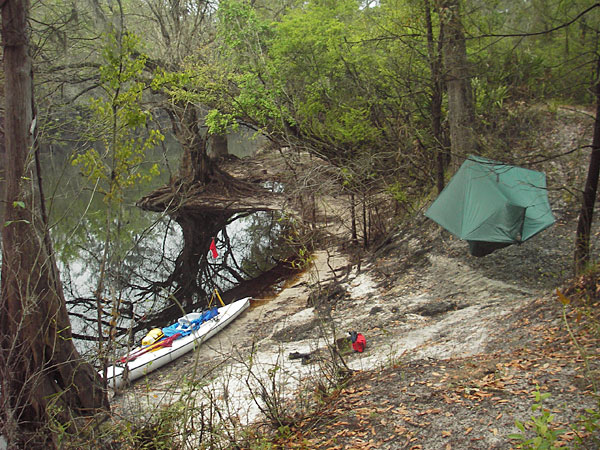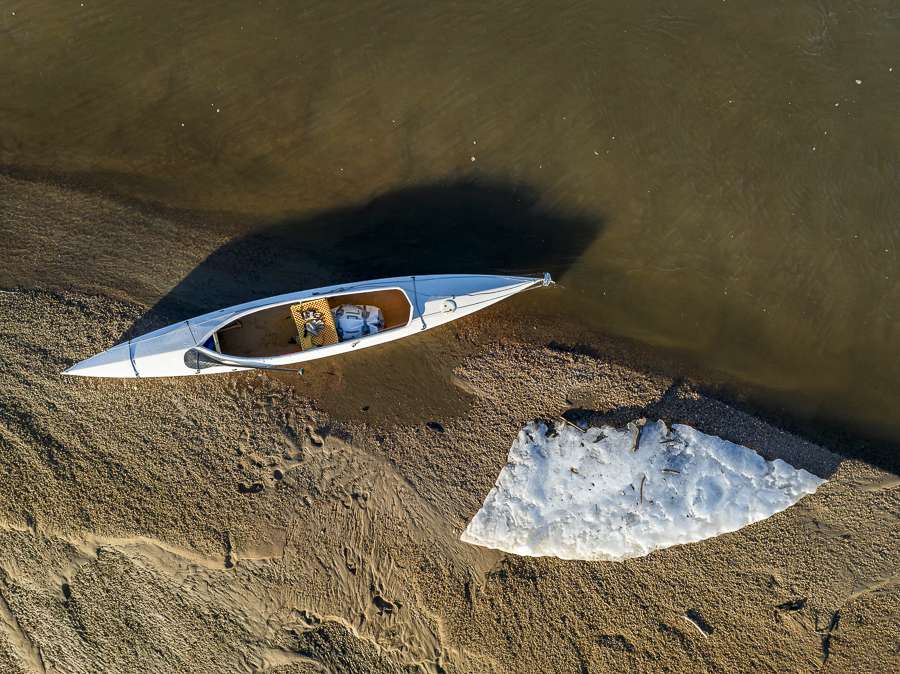
It happens again … I am playing with cameras instead of training. Do I really have to paddle that MR340 race?
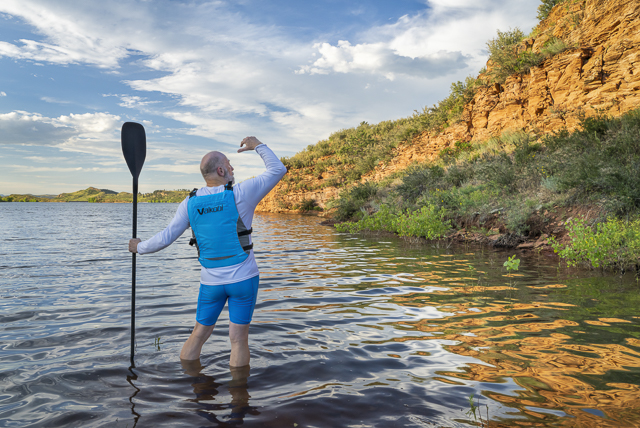
I have recently upgraded from GoPro Hero 2 camera to Hero 3 (black edition). Let’s look at some pictures from my recent paddling on Beaver Pond in Arapaho Bend Natural Area in Fort Collins.
First, the old GoPro Hero on a bow of Badfish SUP with an improvised suction cup mount. There are more pictures from the cloudy day paddling showing details of a camera mount in Paddling with a Camera blog. The first sunny picture above shows a smoke plume from the recent Galena wildfire behind me. It was less smoke on the lake than in my backyard.
Now, GoPro Here 3, but with a different boat – Sea Wind canoe, so a little bit of “sit down” paddling with a somewhat better weather. I had a company of a young eagle fishing on Beaver Pond. It went down to water twice, but I don’t think it did catch anything.
The quality of pictures from GoPro Hero 3 is much higher. I am going to perform a more detailed, side by side, comparison of Hero v.2 and v.3 including also my my current “life jacket camera”, Pentax Optio WG2.
It is a different natural area in Fort Collins – Riverbend Ponds. I am testing a new idea for a camera mounting. No suction cups. Details are coming soon.
Read the full story »
Paddling JKK Supernova kayak below Plumb Ditch Dam on the South Platte River near Greeley. The picture was shot with Canon 5D camera with a timer control on a tripod.
June biking and packrafting trip on the South Platte River
A collection of links to articles in my blog and other on-line resources.
The 2nd Wyoming Outback Challenge on the North Platte River organized by Canoe Colorado took place on May 25, 2008, during Memorial Day weekend.
February 2, 2013. I finally started my 2013 paddling season with the Badfish SUP on the South Platte River. I made 1.5 miles upstream from Kersey. It was a quite intense hour of paddling followed by 15 minutes of lazy downriver floating.
The river is pretty low (~500cfs at Kersey) this winter, but it was deep enough to use a center fin on my SUP. Paddling upstream without the fin would be really challenging. I had to drag Badfish over shallow only a couple of time when landing on gravel bars. The river has the same character all the way down to Kunner. It is shallower and faster upstream of the confluence with the Poudre River. So, when paddling SUP from Evans to Kersey you can probably find a few spots to shallow for a fin.
I was not alone on the river. I met a couple in canoe going downriver from Miliken (hwy 60) to Kersey. Earlier that day Jeremy Rodgers was training upstream of Fort Lupton – “Gage said 280 and it was just fine or slightly more than barely enough!”
It was good to be on water again. I had a long break in my paddling, more than 1.5 months. We had some winter weather in northern Colorado and all local lakes are frozen, but the main reason of my absence from paddling was a long and nasty cold.
The 11.6′ Badfish MCIT inflatable SUP was just added to my paddling fleet. MCIT stands for Multi-Chamber Inflatable Technology. My motivation or excuses if you prefer for another paddleboard were following:
I am moving some posts from the old blog to the current Fitness Paddling blog. Here are some reflections on my 2005 racing. It was the the year of my last Texas Water Safari.
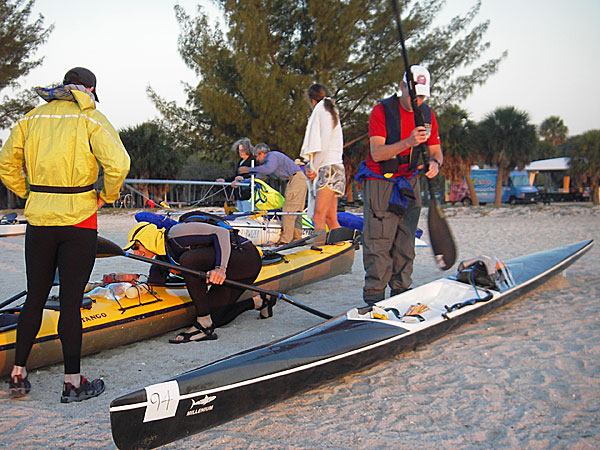
It was also a year when I started to use my first waterproof point-and-shoot digital camera, Optio Pentax WP. It introduced a revolution to my paddling photography. After upgrading a couple of time, I am using Pentax Optio WG-2 today as my main paddling camera. It is always attached to my life jacket.
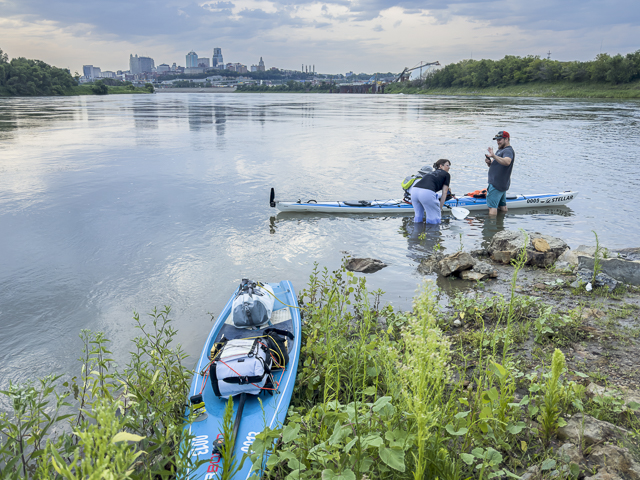
Missouri River 340 or Missouri American Water MR340 is an ultra marathon paddling race from Kansas City to St Charles. 340 miles with 88 hour time deadline. The 8th edition of this race will take place from July 23 to July 26 this year.
A variety of boats are participating in this long race including kayak, surfski, canoe, outrigger canoe, stand up paddleboard (SUP), voyager canoe, dragon boat, pedal kayak. Is it possible to finish the race in a slow boat? I mean a really slow boat. Let’s take it to the extreme.
The slowest boat in my paddling fleet is the Alpacka Yukon packraft. I can maintain a cruising speed in calm water conditions of 2.5 mph. Let’s say that the river current can add 2 mph to this amazing speed. 4.5 mph overall speed means about 75 paddling hours which leaves still 13 hours of resting time within the 88 hour time limit. The river can add more speed, but a rough water or head wind can slow me down. I still need a very comfortable seat and an aggressive body maintenance to survive to survive 3.5 days of a such sedimentary life.
There is one problem with this plan … The time deadlines at the first couple of checkpoints are designed to filter out slow boats. You need to keep the average speed of 5.6 mph for the first 83 miles to Waverly. I think that with a cooperating river it would be possible to make it. If not, I would be disqualified, but I would have a chance to finish within the overall time limit the race course unclassified.
The packraft idea has a certain attraction to me if I could use a bike to shuttle back from St Charles along Katy trail to Kansas City. This would be a nice self contained expedition. My regular shuttle by Amtrak would be just too easy with a 5lb packraft.
After 2 months of paddling my Bark Expedition SUP on calm waters of local ponds in Fort Collins I decided to take a next step. It was time to open winter paddling season on the South Platte River.
So, I bought a shorter flexible fin (7″ Proteck Super Flex) for my paddleboard and did upstream/downstream workout starting at Kersey on November 3.
Beautiful sunny weather, a good river flow (~700cfs), and a very intense paddling workout. The flexible fin was quite useful when approaching shores or gravel bars. I would have to be much more careful if paddling with my regular 8″ Surftech fin.
All pictures were shot with GoPro Hero camera suction cup mounted on a paddleboard bow.
Related posts:
To SUP or to Not SUP? Picture gallery.
South Platte River below Denver, Colorado – GPS/photo river guide. Links to flow data.